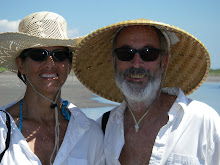
Just as a reminder, I joined my dad and stepmom (Diane) in early
January in northern Mexico on their sailboat to sail south to Ecuador.
We started in Guaymas, in Sonora, Mexico, crossed over to the Baja
Peninsula and travelled south to La Paz. From there we again crossed
the Sea of Cortez to Banderas Bay (where Puerto Vallarta is located)
and began again to travel south to Huatulco…

After travelling at a break neck speed (for a 6 knot per hour boat)
from the north of Mexico to Huatulco in southern Mexico, we were dead
tired of travelling and ready for a welcome break. So it was perfect
timing for Benjamin to meet up with me in Puerto Angel (just a day's
travel north of Huatulco). There he was treated to a week of the 'hard
life'...lounging around, snorkelling, and sightseeing. He and I even
managed to take a brief trip inland to the city of Oaxaca. Which is an
absolutely fabulous city filled with history, local arts and
CHOCOLATE! After Benjamin returned to Washington, we stayed on in
Huatulco so that Dad and Diane could do their taxes and then we had to
wait for the right weather window. So, after three weeks, we finally
made it out of the harbor and said goodbye to Mexico. It took five
days, day and night, of sailing to make land again in northern
Nicaragua. Though the currents were with us, it felt like the waves
were against us and we all suffered a bit from seasickness. Since we
were constantly on the move, someone had to always be on watch, even
at 3am. I happened to have the 2am-5am shift. At that time of year
(late April) we were getting into the storm season in Central America.
Every night, as the light faded, the electricity in the balmy air was
palpable and the clouds overhead were constantly alight. On one of
these intense nights, I had my first experience dodging squalls (a
sudden and intense storm). At night they were only visible by radar,
where they showed up like big, moving blobs. It was like playing a
computer game, trying to avoid being hit by the 'blob'. Unlike a
computer game, though, there were real-world consequences to losing.
If one isn't prepared for a squall and has full sails up, the force of
the wind can (in extreme cases) knock your boat over. Partly by luck
and partly by caution, we managed to avoid this. Actually, contrary to
what one might believe, storms aren't the most dangerous thing that
can occur on the ocean. Colliding with objects (including boats) is
more common and dangerous. Therefore, we had to be especially alert
and careful at night where distances are hard to assess and the lights
on the horizons that looked deceptively far away could actually be
local fishing boats too close for comfort. I spent my hours on watch
fighting against sleep, standing at the hatch feeling the wind play
against my face and staring at the black horizon trying to decide
whether the light I see ahead is a rising star or a fishing boat and
going below to check the radar for squalls and to mark our position on
the chart. As one might well imagine, spending three hours on watch
alone with no one but the wind, stars and ocean as companions, can
lead to thoughtful thinking and observations of the world that
surrounds us.

Travelling by sea provides one with ample opportunity to see marine
life. I saw dolphins, whales, boobies and so many turtles that they
became just another feature of the landscape. One of the more
interesting sights, though, can only be witnessed on moonless nights.
The oceans are filled with a type of plankton (I think?) that emit
light when disturbed. If I remember correctly from my readings in
biology, there isn't any agreement for exactly *why* this occurs –
why
this would be important evolutionally – but a discussion about this
is
beyond the scope of this letter. The ocean is just as active at night
as day and these bioluminescent creatures highlight the drama beneath
the surface. During our night travels we passed through swarms of
jellyfish that lit up the dark sea like basketball sized bombs
exploding into light in every direction you looked. The dolphins,
which hitch a ride in our bow wave, appear in the water as a set of
aqua green torpedoes, travelling with speed and accuracy toward their
target. Though you cannot actually see the dolphins, they wear a
shimmering dress that outlines their form and trails behind them as
they dive and perform acrobatic stunts.

The balmy heat of Mexico increased in intensity as we travelled south
and was unrelenting even at night. I had long abandoned my quarter
berth for a rotating place in the two-person v-berth bed. There was
only a small fan in this cramped room and the nights could be
stiflingly hot which made sleeping difficult especially as our nights
were broken into watches (3 hours on watch, 6 hours for rest). After 5
nights of disrupted and poor quality sleep and days fighting
seasickness and boredom we came into dock on a peaceful, cloudy
morning in Nicaragua. We were exhausted and wanted nothing more than
to just stay still...to literally stop moving...for a moment. We were
in this frame of mind when we were faced with the decision of pushing
through and getting to Ecuador before the storm season hit Central
America in earnest (in May-June) or laying low and waiting it out
before heading south. If we headed south, we would have needed to do
it in a hurry, missing everything in between, including Panama, which
Dad and Diane had been particularly eager to see. My time travelling
on the boat was coming to an end regardless of our decision so it was
ultimately up to them. You needn't be Einstein to deduce that we
decided to stay in Nicaragua instead of high-tailing it to Ecuador.
Realizing that we would not be travelling further south than Nicaragua
was difficult for me at first especially as I had been anticipating
seeing more of Central America and Ecuador. And you can imagine my
disappointment upon learning that I would not have a chance to buy a
Panama hat! ;-) The upside was that we had plenty of time to see and
get to know Nicaragua.

When we landed in Nicaragua, I was under the expectation that this
country would be similar to Costa Rica, as it is its neighbour.
However, the Nicaragua that I came to know left me with a different
impression. We made land in late April which is toward the end of the
dry season and the northwest section, the flattest and driest part of
the country, the land, the people and especially the animals had a
distressed look. In the marina in Northern Nicaragua, where we stayed
for several weeks, I felt conspicuous. I was one of the 'rich'
foreigners. And it was true, we were incredibly rich in comparison to
the locals. One boat in the marina was reputed to be valued at $10
million. $10 million!!! Such conspicuous wealth on display seemed
callous, in a region where the people are so poor that electricity and
indoor plumbing are fabulous extravagances – where the homes are
mostly made from mud and palm fronds – the nicest of which are one
room buildings fashioned from cinderblocks. This is a land where old
men and young children help put food on their tables by smashing rocks
with a hammer to make gravel to sell. Here, emaciated horse and donkey
drawn carriages are almost as frequent on the roads as the cars. Here
too, the ghosts of their civil war of 25 years ago are still plainly
visible – machine gun bullet holes scar the walls of many buildings,
crippled men populate their cities and Sandinista flags are still
painted onto available surfaces throughout the countryside. So, when I
heard about the local men using bombs to fish, knowing how wasteful
and damaging this method of fishing is for the marine environment, I
still had a hard time faulting them. They're destroying their own
environment to get ahead, to give to their families what they can. We
did the same, we destroyed much of our environment to attain the
position of wealth that we have. It is just such a pity, though, to
know that the pristine, almost untouched wildness of this part of
Nicaragua is soon to be consumed by developments – making second
homes
and paradise hotels for rich foreigners. Change is in the air. I feel
lucky, I suppose, to have glimpsed a land almost untouched, whose
existence is ephemeral. But man's greed is dependable and unwavering.

From northern Nicaragua we travelled south to San Juan del Sur, a
small surf town becoming more and more popular with tourists,
especially as Costa Rica becomes more overrun by international
tourists. We travelled there with another boat we met in Puesto del
Sol, who just happened to be avid surfers (from California, of
course). I tried my hand at surfing, discovering why female surfers
don't use bikinis (you can imagine, I'm sure). Riding a wave has its
allure, to be sure. It is exhilarating and challenging feeling the
power of the ocean. But in some ways seems to be a futile. Paddle out
into ocean and be carried back to shore. Making your way out to the
surf break and then being carried back over and over like a young and
lonesome child making its way into the bedroom of its mother only to
be carried back. It takes a special person to ask to be battered,
pounded and abraided over and over. It was a great experience but I
doubt I could ever love it - live for it. But back to the story, the
whole point of heading south to San Juan del Sur was for its
convenient access to Lake Nicaragua, or Lago de Granada as it called
locally, and the sites to see near it. Thus we headed inland to the
shore of this grand lake and took a dilapidated carriage taxi drawn by
a tired, emaciated horse to a ferry which I doubt will be making the
crossing for many more years (or maybe months...). The island of
Omtepe in the Lago Granada is gorgeous views of Volcán Concepcíon.
One
can also make the difficult trek up the side of the older volcano
which we didn't climb, instead we took a bike ride on horribly
uncomfortable bikes and visited a local spring to swim and relax by.
After a quick visit to Granada and a wonderfully refreshing hike on
the top of a nearby volcano we returned to Puesto del Sol where I
waited for my return to Colorado.

And on this note I will leave you until next time…keep an eye peeled
for the exciting continuation of my adventures. I love and miss you
all and though I may not be the best at correspondence, you are in my
thoughts and memories!

Much love,
Erica
I have also begun to upload pictures to an online album which
you can view at http://picasaweb.google.com/aserica
var callCount = 0; function rmvScroll( msg ) { if ( ++callCount > 10 ) { msg.style.visibility = "visible"; } if ( callCount < delta =" msg.offsetHeight" newwidth =" 0;" newheight =" 0;" delta =" ("> msg.clientHeight ) { newHeight = msg.scrollHeight + delta; } delta = msg.offsetWidth - msg.clientWidth; delta = ( isNaN( delta )? 1 : delta + 1 ); if ( msg.scrollWidth > msg.clientWidth ) { newWidth = msg.scrollWidth + delta; } msg.style.overflow = "visible"; msg.style.visibility = "visible"; if ( newWidth > 0 || newHeight > 0 ) { var ssxyzzy = document.getElementById( "ssxyzzy" ); var cssAttribs = ['#' + msg.id + '{']; if ( newWidth > 0 ) cssAttribs.push( 'width:' + newWidth + 'px;' ); if ( newHeight > 0 ) cssAttribs.push( ' height:' + newHeight + 'px;' ); cssAttribs.push( '}' ); try { ssxyzzy.sheet.deleteRule( 0 ); ssxyzzy.sheet.insertRule( cssAttribs.join(""), 0 ); } catch( e ){} } } function imgsDone( msg ) // for Firefox, we need to scan for images that haven't set their width yet { var imgList = msg.getElementsByTagName( "IMG" ); var len = ((imgList == null)? 0 : imgList.length); for ( var i = 0; i < theimg =" imgList[i];" naturalwidth ="=" msg =" document.getElementById(" visibility = "visible">